Thursday, March 3, 2011

Childrens Of Industries

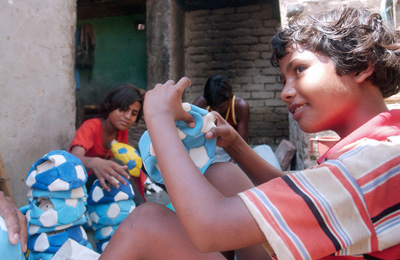
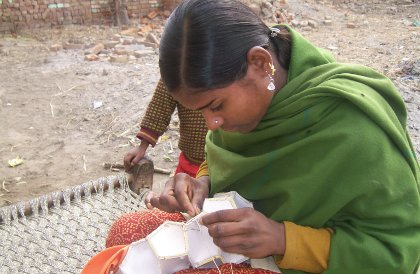
Children of Industry” shows how thousands of children in India, as young as age 6, work about 15 hours a day, crouching on dirt floors, stitching soccer balls for five cents an hour or nothing at all. One 12-year-old girl is paid 15 cents for a ball that sells in the U.S. for $15. She tells of having back problems due to being crouched  all day, and her eyes hurt from finding the small holes to thread the string. Children regularly cut their fingers cutting the string with a sharp ustensil.

The soccer balls made by child labor in India are made for over 10 international companies, including Mitre, whose soccer balls are used by the U.S. pro soccer league and by the most prestigious soccer league in the world, England’s Premier League.

The soccer industry, from the sporting companies, to the U.S. government, to the stores that sell the balls, all officially prohibit the use of child labor, and there is wide-spread denial that children are used to make these soccer balls. Despite these claims of no child labor, Real Sports with Bryant Gumbel traced the UPC codes of the balls made by children in India to balls sold by Walmart in the U.S. All those balls have a label on them that states, “Child labour free production.” Who stitched on those labels? Children!





http://revcom.us/a/145/soccer_balls-en.html

Sunday, February 27, 2011

Nike using kids for their soccer balls!

Nike has been accused of using child labor in the production of its soccer balls in Pakistan. This case study will examine the claims and describe the industry and its impact on laborers and their working conditions.


Pakistan has a per-capita income of $1,900 per year, meaning that a person survives barely on $5 per day. And that's not all, Pakistan has a traditional culture where earning of one person goes on feeding 10 other persons and with the high rate of augmentation it becomes difficult for a low income population to survive.


Recently if you go to a shop to buy your child a new soccer ball, there is a good possibility that the ball has been made by someone your child's age or even younger. About half of the world's soccer ball are made in Pakistan, and each one of them passes through a process of production where child labor is involved. This problem not only pertains to Pakistan but is worldwide. More than 200 children, some as young as 4 and 5 years old, are involved in the production. Majority of these children work in Asia, e.g in the nations of India, Pakistan, Bangladesh and Indonesia.


http://www1.american.edu/ted/nike.htm

Friday, February 25, 2011

Did you know

Did you know that each year, India produces more than one million hand-stitched soccer balls, most of them are exported for sale to nations around the world, including the United States. In some of the poorest areas of the country, children as young as six play a part in that industry, spending their days  making soccer balls together with little hope of a better life.